
Online Marriage Services in Karachi | Online Nikah in Karachi-Pakistan
Lawyer-Assisted Online Marriage & Online Nikah Services in Karachi
We provide lawyer-assisted online marriage and online Nikah services in Karachi for couples who cannot conveniently be present at the same place, including Pakistanis living in the UAE, UK, USA, Saudi Arabia, Europe, Canada and other countries. Our legal team assists with the complete Nikah process, documentation, identity verification, witnesses, Nikah Khawan coordination, Nikah Nama preparation and guidance regarding marriage registration in Pakistan.
An online Nikah requires proper compliance with the applicable legal and Islamic requirements. The exact procedure may differ depending on whether both parties are in Pakistan, one party is abroad, or a duly authorised attorney must represent one party. Before proceeding, our team reviews the parties’ documents and circumstances to ensure the appropriate procedure is followed.
Online Nikah Assistance for Overseas Pakistanis
If the bride or groom is residing outside Pakistan, our Karachi team can guide the parties on the documents, authority, witnesses, and representation required to complete the Nikah and related documentation in Pakistan.
For Online Marriage / Online Nikah Assistance in Karachi:
Contact our legal team for document review, procedure guidance and appointment arrangements.
Karachi Office: M-51, Muneer Mobile Mall, Block 17, Gulistan-e-Jauhar, Karachi.
What We Assist With
- Online Nikah arrangements in Karachi
- Nikah Nama preparation
- Nikah Khawan coordination
- Witness coordination
- Overseas bride or groom cases
- Document review
- Power of Attorney guidance where applicable
- Marriage registration guidance
Understanding Online Marriage and Online Nikah in Pakistan
Online marriage, commonly referred to as online Nikah in Pakistan, is a marriage arrangement designed for couples living in different cities or countries who cannot conveniently be present in the same location. The Nikah must still fulfil the applicable Islamic and legal requirements, including free consent, proper identification, witnesses, Nikah documentation and registration requirements. Depending on the location and circumstances of the bride and groom, the procedure may involve remote communication, legal documentation or representation through an authorised attorney.
The Ijab-e-Qabul Process in Online Marriage
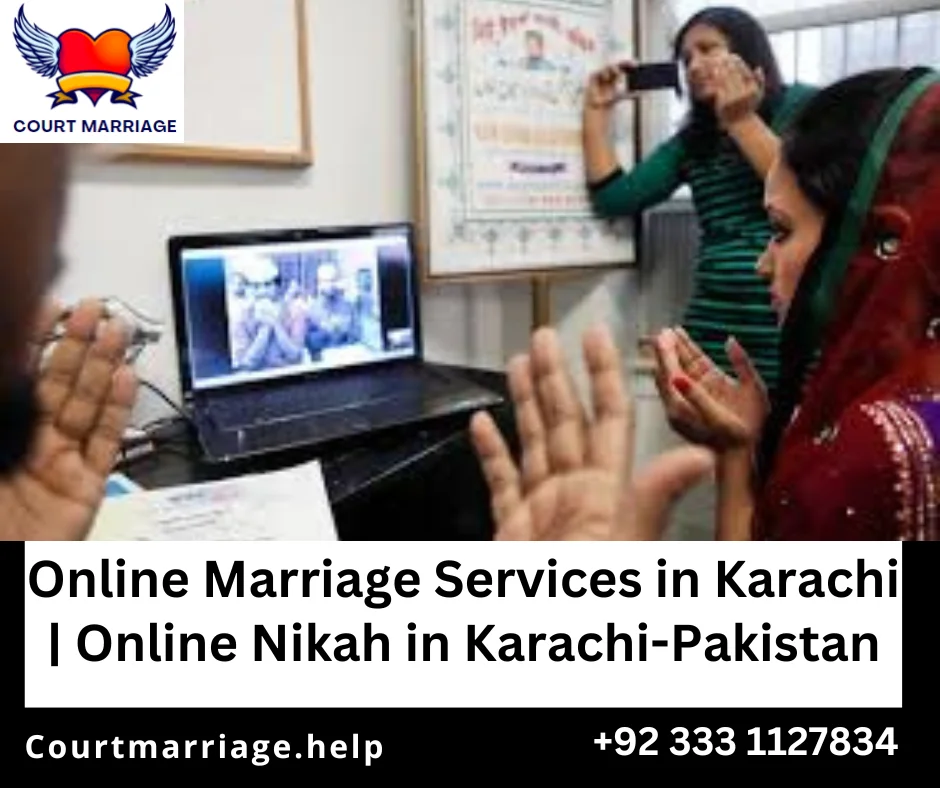
Ijab-e-Qubul (offer and acceptance) is the essential expression of consent through which the parties agree to the Nikah. In an online marriage arrangement, the manner in which Ijab-e-Qubul is conducted depends upon the circumstances of the bride and groom, their locations and the legal procedure being followed. Clear identification, free consent and the presence or participation of the required witnesses must be ensured. Where representation through an authorised attorney is appropriate, the Nikah may be arranged accordingly rather than treating a video call alone as the legal basis of the marriage.
How Does Online Marriage Work in Pakistan?
Online marriage in Pakistan begins with verification of the bride’s and groom’s identities, marital status, current locations and willingness to marry. The required documents and procedure depend upon whether both parties are in Pakistan, one party is overseas, or representation is required. After the legal requirements are determined, arrangements are made for the Nikah Khawan, witnesses, Ijab-e-Qubul, preparation of the Nikah Nama and subsequent marriage registration.
How the Online Nikah Process Begins
The process normally begins with a review of the bride’s and groom’s identification documents, marital status and current locations. Where one party is residing outside Pakistan, the legal team may also determine whether any authority, representation or additional documentation is required.
The appropriate procedure depends upon the individual circumstances of the parties. Documents should therefore be reviewed before the Nikah arrangements are finalised rather than relying upon a single standard online procedure for every case.
Reciting the Khutbah: The Start of the Online Marriage Ceremony
The Nikah ceremony may include the recitation of the Khutbah by the Nikah Khawan before proceeding to Ijab-e-Qubul. The bride and groom’s free consent must be properly established, and the required witnesses must participate in accordance with the applicable procedure. In cases involving an overseas bride or groom, the legal team should first determine whether direct participation or authorised representation is appropriate before solemnising the Nikah.
Completing and Signing the Nikah Nama in Online Marriage
The Nikah Nama must be accurately prepared and completed in accordance with the procedure applicable to the particular marriage. The required parties, witnesses, Nikah Khawan/Nikah Registrar or authorised representatives, where legally applicable, complete the relevant signatures and particulars. The marriage documentation is thereafter processed for registration with the competent local authority so that the registered marriage record or certificate may be obtained.
Legal Recognition of Online Marriage in Pakistan
The legal recognition of an online marriage in Pakistan depends upon whether the Nikah itself and the resulting documentation comply with the applicable legal and Islamic requirements. The use of video communication does not by itself determine the validity of a marriage. Factors such as free consent, identity of the parties, witnesses, proper solemnisation, authority of any representative and registration of the Nikah Nama must be considered according to the circumstances of each case.
Legal Framework for Online Marriage: The Muslim Family Laws Ordinance, 1961
From a legal standpoint, an authoritative reference can be found in the Muslim Family Laws Ordinance, 1961, which governs marriage and family-related issues in Pakistan. While the ordinance does not explicitly address online marriage, it emphasizes the importance of consent and the presence of witnesses for the validity of a nikah. Given this, the primary legal question revolves around whether virtual presence can substitute physical presence for these purposes.
Witness Requirements for Online Marriage under Islamic Law
In practice, Pakistani courts have shown openness to the concept of online nikah, provided that certain conditions are met. Both parties must consent to the marriage while their virtual presence and that of the witnesses are assured. The use of video conferencing tools can be seen as a technological extension of physical presence, thus fulfilling the requirement of witnesses as stipulated in Islamic law. Nevertheless, this recognition is not uniformly applied, and legal opinions can vary among different courts and jurisdictions within Pakistan.
The Council of Islamic Ideology’s Stance on Online Marriage
The stance of religious authorities is also significant in the context of online marriage in Pakistan. The Council of Islamic Ideology (CII), an advisory body that interprets Islamic laws in Pakistan, has opined that online nikahs are permissible as long as mutual consent and witness requirements are satisfied. This perspective provides a critical endorsement, aligning religious acceptability with legal validity. However, it is essential for individuals opting for an online marriage to ensure that the platform or service used for the ceremony adheres to these stipulations.
Legal Age Requirements for Online Marriage in Pakistan
The first and foremost requirement for an online marriage in Pakistan is ensuring the legal age for marriage is met. According to Pakistani law, the minimum age for males is 18 years, whereas females must be at least 18 years old. Before proceeding with the ceremony, couples must provide valid identification documents to verify their ages, such as a National Identity Card (CNIC), a passport, or a birth certificate.
The Role of Consent in Online Marriage in Pakistan
Consent is another indispensable criterion for online marriage in Pakistan. Both parties must willingly and freely consent to the marriage without any form of coercion or undue influence. This consent is often recorded through a video conference, where the individuals verbally confirm their intentions in the presence of witnesses and a marriage officiant. The designated witnesses, typically two adult males, must also provide their identification and confirm their willingness to act as witnesses.
Necessary Documents for Online Marriage in Pakistan
When considering an online marriage in Pakistan, ensuring that all necessary documents are in order is imperative for the process to be legally recognized. The digital nature of the process does not lessen the importance of documentation; rather, it necessitates meticulous attention to detail and accuracy.
Verifying Identities with CNICs and Passports for Online Marriage
The primary documents required are identity proofs for both parties. These typically include National Identity Cards (CNICs) or passports, which serve to verify the identities and nationalities of the individuals involved. Additionally, copies of these documents must be clear and preferably in digital format, as they will be submitted electronically.
Previous Marriage, Divorce and Death Documents for Online Marriage
Applicants who were previously married should provide documents confirming their current marital status. Depending on the circumstances, these may include a previous marriage certificate, divorce decree or divorce certificate, or the death certificate of a former spouse. These records help establish that the previous marriage has legally ended and that the individual is eligible to enter into a new marriage.
Affidavit and Consent Documentation for Online Marriage
An affidavit of consent from both parties is also necessary. This document, which the bride and groom must sign, shows that both parties willingly and knowingly consent to the marriage. For an online marriage in Pakistan, affidavits of consent may need to be notarized or verified by a legal authority to ensure their authenticity.
Embassies and Consulates: Key Resources for Overseas Document Procurement
Those residing abroad can generally obtain these documents through local government offices, embassies, or consulates. In some cases, legal advisors or marriage facilitators specialising in online marriages in Pakistan may help streamline the process and gather and verify the required documents.
Verification and Nikah Arrangements
After the required documents and details are reviewed, the parties are guided on the appropriate Nikah arrangements. This may include identity verification, confirmation of free consent, coordination with the Nikah Khawan and witnesses, and preparation of the Nikah Nama.
If a party is outside Pakistan or cannot personally attend a required step, consider the legal implications of representation before proceeding. The procedure should be structured according to the circumstances of the particular marriage rather than assuming that every part of the process can automatically be completed through a video call.
Costs and Timeframe of Online Marriage in Pakistan
The advent of online marriage in Pakistan has provided a convenient alternative to traditional marriage ceremonies, but it is essential to comprehend the financial and temporal implications of this process. Conducting an online marriage involves several costs, which vary based on the services and legal assistance availed. Typically, the fees include legal consultation, preparation of marriage documents, and registration with the relevant authorities.
Legal Consultation Fees for Online Marriage in Pakistan
Legal consultation costs can range from PKR 35,000 to PKR 50,000, depending on the expertise of the lawyer and the complexity of the case. This fee ensures that all legal requirements are met and that the marriage is valid under Pakistani law. Additionally, the preparation and notarization of essential documents, such as the marriage contract (Nikah Nama) and affidavits, can cost between PKR 10,000 and PKR 25,000. These documents play a crucial role in legitimizing the online marriage.